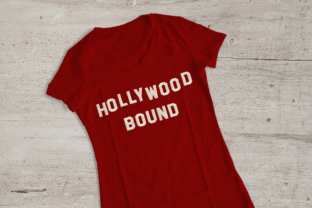
Hollywood Bound Embroidery Review
First Impressions: Glamour, Clarity, and Craftsmanship
As an embroidery designer who’s stitched everything from nursery monograms to boutique apparel lines, Hollywood Bound landed on my screen with instant visual appeal. It’s not just a phrase—it’s a mood. The lettering carries a confident, vintage-meets-modern energy: clean curves, balanced spacing, and a subtle rhythm that reads well at a glance. What stood out immediately was its intentional stitch personality—depending on size, the letters shift between satin stitch (for crisp, reflective definition) and tatami fill stitch (for softer texture and better coverage on textured fabrics). That flexibility tells me this wasn’t auto-digitized; it was considered.
Fits Naturally Into Real Projects—Not Just Mockups
I evaluated Hollywood Bound for actual customer orders: a linen apron for a film school grad, a cotton tote for a travel-themed Etsy shop, and a baby blanket for a “future director” gift set. It works especially well in the Vacation category—not because it shouts “beach!” but because it evokes aspiration, movement, and personal storytelling. Unlike generic script fonts, Hollywood Bound feels intentional enough for branding yet playful enough for handmade charm.
Performance Across Fabric Types & Garment Styles
Apparel & Sweatshirts: On midweight cotton blends, Hollywood Bound held clean edges without puckering—especially when paired with medium-weight cutaway stabilizer. The satin-stitch version shines on dark fabric (think navy sweatshirts), while the tatami version softened nicely on heather grey. Just avoid ultra-stretchy knits unless you’re using a light tear-away + topping combo.
Tote Bags & Kitchen Towels: This design scaled beautifully across 4"–5" hoops—ideal for standard tote front panels or towel hems. Stitch density felt moderate: dense enough to read clearly at arm’s length, but not so heavy that it stiffened lightweight canvas or terry cloth.
Baby Items & Nursery Decor: I tested the smallest recommended size on organic cotton interlock. The letters remained legible, though I’d skip satin stitch under 3" on delicate fabrics—tatami fill gave smoother, safer coverage. For nursery wall hangings or pillow covers, Hollywood Bound adds wit without overwhelming the space.
Caps & Patches: On curved cap fronts, the design held shape well—but only above 3.5". Below that, small serifs lost definition. As an embroidered patch, it worked cleanly on twill-backed blanks, especially with a satin-stitch outline and tatami interior. Great for craft fairs or pop-up merch tables.
What Affects Your Finished Product—and Your Customer’s Trust
Your choice of Hollywood Bound subtly influences how buyers perceive your brand. It reads as confident but approachable—perfect for creative entrepreneurs selling custom apparel or personalized gifts. On Etsy, it pairs well with strong printable mockups: a clean photo of the design on a cream linen tote signals quality craftsmanship before the buyer even reads your description.
More importantly, it supports consistency. If you’re building a themed collection—say, “Dream Big” series for graduation season—Hollywood Bound holds its own visually alongside monogrammed initials or minimalist stars. It doesn’t compete; it complements.
And yes, customers notice the details. One repeat client told me she chose my shop over another because “the stitching looked *even*—not rushed.” That’s where Hollywood Bound delivers: consistent stitch direction, smooth transitions between letters, and no awkward jump stitches visible on the front.
Practical Notes Before You Stitch
- Always test first: Run a sample on scrap fabric matching your final product’s weight and stretch. Check for thread nesting, pull-through on darks, and clarity of small curves.
- Stabilizer matters: Use cutaway for knits and wovens alike. For towels or textured weaves, add a light water-soluble topping to prevent skipped stitches in satin areas.
- Thread color contrast is key: On black or charcoal, go one or two shades lighter than you think—cream or soft gold reads cleaner than stark white. On light fabrics, deep navy or burgundy adds richness without harshness.
- Review hoop size vs. design dimensions: Don’t assume it fits your smallest hoop. Measure the design width in your software—even if listed as “4-inch,” account for seam allowances and hooping margins.
- Inspect after stitching: Trim jump threads carefully. Small inner corners (like the counter of the “O” or “D”) can trap lint—use a seam ripper tip to gently lift and clear.
- Verify licensing: Since this is a Creative Fabrica embroidery file, double-check the product page for commercial use terms before listing finished items on Etsy or wholesale platforms.
When Hollywood Bound Might Not Be the Right Fit
This isn’t a one-size-fits-all machine embroidery design. Skip it if you need ultra-minimalist typography, photorealistic detail, or layered applique elements. It’s also not optimized for sub-2.5" applications—tiny lettering loses impact and risks breakage on frequent-wash items like baby onesies. And while it’s versatile, it won’t replace a custom monogram or logo for long-term brand identity work.
Final Thought: A Reliable, Character-Full Design Asset
Hollywood Bound earns its place in my working library not because it’s flashy, but because it’s dependable. It stitches cleanly across common substrates, scales thoughtfully, and carries tone without shouting. For creative entrepreneurs building handmade product lines—whether for craft fairs, seasonal Etsy drops, or local boutique consignment—it’s a smart, low-risk digital embroidery file that delivers real value. It reminds me that sometimes the strongest design choices are the ones that feel effortless to use and authentic to share.