Recycled Rainbow Flower
A Designer’s First Glance: Joyful, Balanced, and Quietly Bold
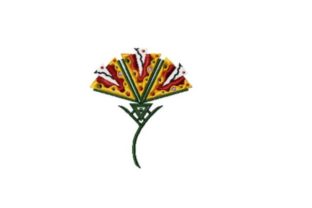
When Recycled Rainbow Flower first loaded into my embroidery software, I paused—not because it’s flashy, but because it breathes. The shape is a stylized bloom with soft, overlapping petals that curve inward like a gentle invitation. There’s no aggressive symmetry or rigid geometry; instead, it feels hand-drawn in spirit, even though it’s clearly optimized for machine embroidery. The “recycled” in the name isn’t just thematic—it shows in how elements echo and layer without redundancy. Petals share subtle stitch direction shifts, and the center isn’t overfilled; it uses a light satin stitch that lets fabric peek through. That restraint makes it feel intentional, not automated.
Where It Lives Best: Real Projects, Real Reactions
Last week, I stitched Recycled Rainbow Flower onto a natural linen tote bag for a local boutique’s spring launch. No embellishment—just the design centered on the front panel, using tonal ecru thread on oat-colored fabric. Customers stopped mid-aisle. Not to ask “what’s that?” but to say, “I *need* that bag.” Why? Because the design reads as both cheerful and grounded—its rainbow palette isn’t neon-bright, but warm and muted (think terracotta, sage, buttery yellow), making it wearable across ages and styles. I’ve since used it on baby onesies (scaled down 20%), organic cotton tea towels (with a lightweight tear-away stabilizer), and as an embroidered patch sewn onto denim aprons for a craft fair vendor. In every case, it elevated the handmade product without shouting.
Sweatshirts & Tote Bags: A Natural Fit
Recycled Rainbow Flower lands beautifully on medium-to-heavy fabrics where stitch definition holds. On fleece-lined sweatshirts, its moderate stitch density prevents stiffness while keeping petal edges crisp. For tote bags—especially canvas or duck cloth—it reads cleanly at 4–5 inches wide, with enough negative space between petals to avoid “mushing” on textured surfaces. As a tote bag design, it adds personality without overwhelming branding. Etsy sellers will appreciate how well it photographs in natural light: no glare, no thread pooling, just quiet clarity.
Baby Items & Delicate Surfaces: Proceed Thoughtfully
This isn’t a go-to for newborn onesies *unless* you reduce size and simplify stabilizing. The outer petals have fine tapered ends—lovely in theory, but on ultra-thin interlock knit, they can tunnel or fray after washing if not hooped precisely. Same goes for curved surfaces like caps: the design’s gentle asymmetry means it won’t distort badly, but avoid placing it too close to the bill seam where tension shifts. For baby embroidery, I recommend stitching a test version on scrap knit first, then checking wash durability with a gentle cycle and air dry.
What It Does for Your Craft Business—Beyond the Stitch
As a digital embroidery file, Recycled Rainbow Flower strengthens perceived value. It doesn’t look mass-produced—it looks curated. That matters when you’re pricing personalized gifts or small shop products. A customer paying $48 for a custom-embroidered pillow cover isn’t just buying thread and fabric; they’re buying intention, care, and visual harmony. This design delivers that. Its color transitions feel cohesive, not arbitrary—so whether you stitch it in pastels for a nursery decor piece or deep jewel tones for a holiday embroidery gift, the mood stays consistent. For boutique branding, it works as a subtle logo alternative: recognizable at a glance, scalable, and emotionally resonant without being cutesy.
Where Caution Keeps You Professional
On dark fabric? Test thread contrast first. Some lighter hues in the rainbow may disappear against charcoal or navy unless you adjust top thread or add underlay. On stretchy fabric like jersey, use cutaway + topping—and skip the satin-center variation unless your machine handles dense satin stitch reliably. Also: inspect corners. While not overly intricate, the inner petal curves do tighten near the center. If your commercial embroidery machine has older firmware, run a quick simulation to confirm jump stitches don’t land awkwardly.
Practical Designer Notes You’ll Actually Use
- Always test on scrap fabric first—especially if pairing with textured weaves or eco-blends (like recycled cotton/poly blends).
- Check stitch density visually in your software. Recycled Rainbow Flower avoids excessive fill, but zoom in on petal overlaps to confirm no unintended double-stitching.
- Confirm hoop size compatibility before digitizing for production. Its balanced proportions fit standard 4x4 and 5x7 hoops—but verify clearance if adding text or borders later.
- Review small details at 200% zoom: those petal tips should taper cleanly, not end in jagged stops.
- Test black-and-white mockups to assess silhouette strength—this design holds up well, making it versatile for printable mockups or monochrome branding.
- Use appropriate stabilizer: medium-weight cutaway for knits, tear-away for stable wovens, and water-soluble topping for shiny fabrics like satin.
- Verify licensing before selling finished items or bundling the digital embroidery file. Since it’s described as “original quality embroidery,” assume personal and small-batch commercial use is intended—but always confirm terms directly with the creator.
Final Thought: It’s Not Just a Design—It’s a Conversation Starter
I’ve stitched hundreds of floral machine embroidery designs. Most fade into background charm. Recycled Rainbow Flower does something rarer: it invites pause, then connection. A mom at the craft fair pointed to it on a bib and said, “That reminds me of my grandmother’s garden—she saved seeds every year.” That’s the quiet power here. It’s not loud, but it’s memorable. Not complicated, but it rewards attention. Whether you’re an Etsy seller building a cohesive collection, a small shop owner refreshing seasonal merchandise, or a hobbyist stitching heartfelt personalized gifts, this design earns its place—not because it’s trendy, but because it feels true. And in embroidery, that truth translates directly into trust, repeat customers, and handmade products that people keep.