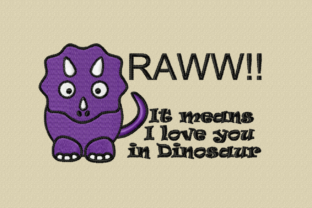
Raww I Love You
A Practical Embroidery Designer’s Review for Small Business Merchandise
As an embroidery designer who’s digitized over 2,000 commercial projects—from café aprons to boutique tote bags—I approach every new machine embroidery design with two questions: Will it hold up in production? and Does it strengthen the brand—not just decorate it? That’s why I tested Raww I Love You across real small business use cases: staff uniforms for a local florist, embroidered patches for a pet-themed Etsy shop, cap fronts for a creative studio, and sleeve accents on reusable tote bags for a neighborhood bakery. Here’s what stood out—and what demands attention before you commit.
First Impression: Playful, Handmade, and Instantly Relatable
From the title alone—Raww I Love You—you sense warmth, humor, and intentional imperfection. It doesn’t try to be sleek or corporate. Instead, it leans into a friendly, slightly rustic charm that aligns beautifully with handmade product branding. The mention of dinosaurs in the description confirms its lighthearted personality: not cartoonish or juvenile, but affectionate and character-driven. For small businesses that lead with authenticity—think indie bakeries, craft studios, or pet wellness brands—this tone builds immediate emotional resonance. It feels like a wink, not a sales pitch.
Real-World Performance Across Merch Channels
Raww I Love You shines where personality matters most: on embroidered patches, apron pockets, and tote bag corners. Its balanced proportions and open letterforms translate cleanly at 2.5"–3.5" heights—ideal for chest logos on work shirts or front-facing cap embroidery. On textured fabrics like canvas tote bags or linen aprons, the design’s moderate stitch density holds definition without puckering, especially when paired with medium-weight cutaway stabilizer.
For boutique merchandise, this machine embroidery design works double duty: as both a functional brand marker and a subtle conversation starter. A florist added Raww I Love You to the hem of reusable cotton drawstring bags—and customers consistently commented on the “sweet, unexpected detail.” Similarly, a pet brand used it as a custom embroidered patch on bandanas, reinforcing care and playfulness without relying on clichéd paw prints or bones.
In uniform settings—like staff aprons for a ceramic studio or embroidered caps for a garden center—the design reads clearly from 6 feet away. Its bold “R” and “W” anchors visual weight, while the rounded “o” and soft “v” curves keep it approachable. Unlike tightly kerned or overly stylized fonts, Raww I Love You avoids legibility pitfalls on curved surfaces (e.g., cap fronts) or stretchy fabrics (e.g., performance-blend tees), provided proper underlay and stabilizer are used.
Where to Use It Thoughtfully
While versatile, Raww I Love You isn’t universally scalable. Avoid using it smaller than 1.75" wide on patches—fine details in the “w” and tail of the “y” risk blending or fraying after repeated washing. On dark uniforms (especially navy or charcoal), confirm thread color contrast: light ecru or heather gray may disappear; opt for high-contrast options like cherry red or cobalt blue instead.
Also proceed with caution on highly textured or napped fabrics (e.g., fleece, terry cloth, or heavy twill). The design’s moderate fill areas can sink into pile if stabilizer is undersized or hooping tension is inconsistent. And because it includes expressive line work—not just solid fills—always test on your exact fabric blend before bulk production.
How It Shapes Brand Identity and Customer Trust
Small business merch isn’t just about visibility—it’s about signaling values. Raww I Love You quietly communicates care, creativity, and human-centered design. When stitched onto a handmade soap label or a ceramic studio’s packaging accent, it elevates perceived value—not through luxury cues, but through warmth and intentionality. Customers don’t just see a logo; they feel invited in.
That emotional layer translates directly to engagement. Etsy sellers report higher photo saves and cart additions when Raww I Love You appears on product tags or gift wrap accents. Why? Because it reinforces handmade presentation without shouting “handmade.” It’s consistent enough for visual cohesion across design assets (e.g., matching social banners and embroidered patches), yet distinctive enough to stand apart from generic script fonts.
Essential Embroidery Designer Notes Before Production
- Always test in black and white first. Confirm legibility and spacing without color distraction—especially critical for client approvals.
- Verify small-patch viability. Resize the embroidery file to your target patch dimensions (e.g., 2" x 1.25") and check outline integrity in your editing software.
- Review thread color contrast on your base fabric. Print a physical swatch mockup—not just a digital preview—to assess how light/dark threads interact with texture and weave.
- Inspect letter spacing and kerning. Tight spacing between “w” and “I” or “u” and “Y” can cause thread nesting—adjust manually if needed.
- Confirm hoop size and stabilizer match. This design performs best in standard 4" x 4" hoops with medium-cutaway stabilizer on midweight cotton or poly-cotton blends.
- Test on real fabric—not just tear-away. Run a sample on your exact tote bag canvas or apron linen to evaluate stitch lay, density, and wash durability.
- Create a printable mockup for client sign-off. Show Raww I Love You on actual garment photos—not flat templates—to set accurate expectations.
- Compare beside existing design assets. Does it harmonize with your current logo, website typography, or packaging palette? Consistency builds recognition faster than novelty.
- Confirm commercial licensing. Since this is a digital embroidery file intended for small business merch, ensure your purchase includes rights for resale, promotional use, and branded patch production.
Bottom line: Raww I Love You isn’t just another dinosaur-themed embroidery file. It’s a strategic, emotionally intelligent tool for small businesses building memorable, tactile brand experiences. Used intentionally—with attention to fabric, scale, and context—it transforms everyday items—aprons, caps, totes, patches—into quiet ambassadors of care, creativity, and connection. For embroidery shops and apparel decorators, it’s a reliable, repeatable asset. For handmade brands and Etsy sellers, it’s a shortcut to warmth that scales.